How to Adjust Iron Sights in Seven Simple Steps
Struggling to get your shots on target? You’re not alone—many gun enthusiasts find it tricky to properly adjust their iron sights for accurate shooting. But don’t worry, with a little guidance, you can master this essential skill quickly.
To adjust your iron sights in seven simple steps, start by gathering tools like a screwdriver and cleaning supplies. Check your current sight alignment and zero point, then understand how to adjust the front and rear sights.
Fine-tune the elevation for better distance accuracy, test at the range, and troubleshoot any issues like loose screws or misalignment. Regular maintenance helps keep your sights precise.
Keep going—more tips await to help you master sight adjustments.
Key Takeaways
- Ensure the sights are clean, free of damage, and properly aligned before you start making adjustments.
- Use the right tools, like a screwdriver or Allen wrench, to adjust windage and elevation.
- Begin by sighting in at a close distance to confirm your initial zero, then move to longer ranges.
- Make small, incremental adjustments and test your shot groups after each change.
- Keep track of your settings and check your accuracy at multiple distances for consistent precision.
Why Proper Iron Sight Adjustment Boosts Shooting Accuracy
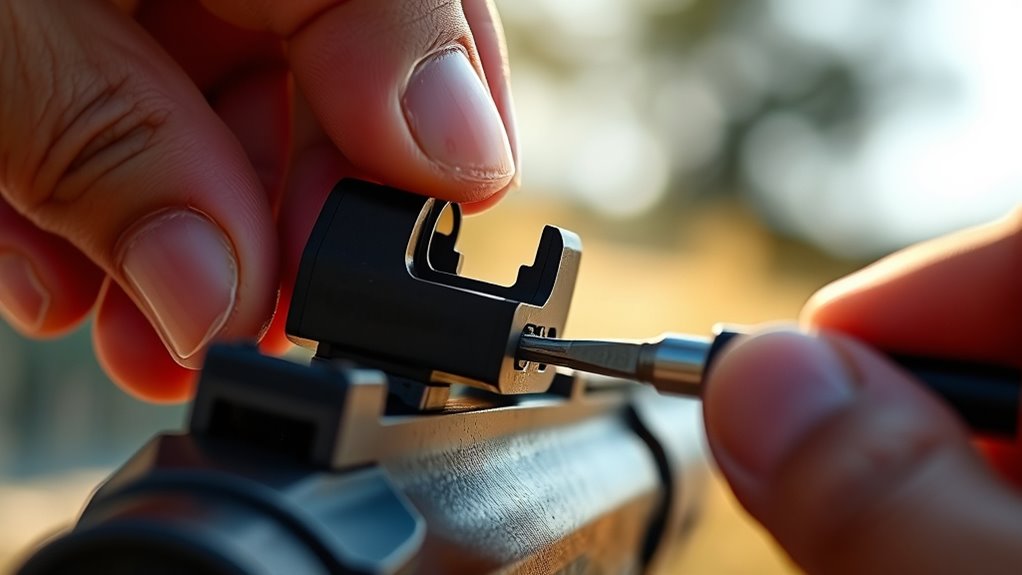
Have you ever wondered why your shots aren’t hitting the target consistently? Proper iron sight adjustment plays a vital role in improving your shooting accuracy.
This technique has a rich historical significance—soldiers and marksmen for centuries relied on precise sighting methods for effective aiming, a practice that has evolved with time.
Thanks to technological advancements, modern iron sights are now more precise and easier to align than ever before. Correctly adjusted sights help you maintain consistent shot placement, reduce guesswork, and build confidence in your abilities.
When your sights are properly aligned, your focus shifts from aiming errors to executing your shot. This precision wasn’t always achievable without the progress made in sight manufacturing and design, but today’s advancements continue to highlight the importance of perfect alignment.
Ultimately, taking the time to ensure your iron sights are properly adjusted transforms your shooting experience from frustrating to accurate.
Gather Essential Tools for Iron Sight Adjustment
If you’re looking to fine-tune your iron sights, you’ll want to gather a few key tools first. Things like a small screwdriver, a punch or pin tool, and a bore sight or a target for alignment are really handy.
Having these tools ready means you can make those precise adjustments quickly and without hassle. It makes the whole process much more straightforward, so you can get your sights set just right.
Tool Collection Essentials
Ensuring you have the right tools on hand makes adjusting iron sights straightforward and efficient. Start with a small screwdriver or Allen wrench that fits your sights’ screws, so you can make precise adjustments.
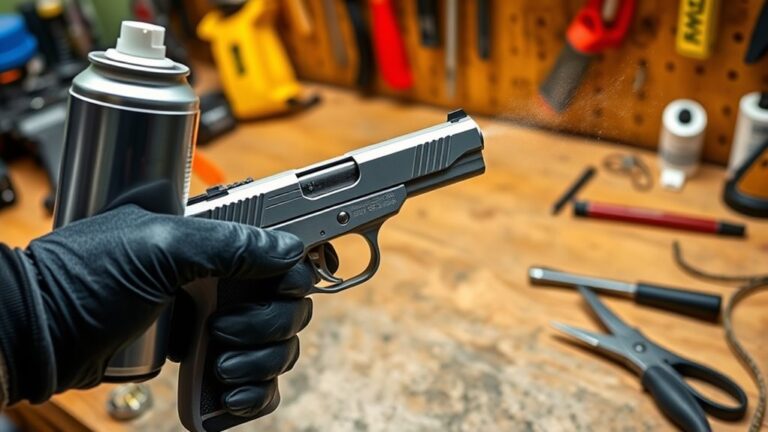
A cleaning cloth and brush are essential for gun cleaning before adjustments, making sure no dirt hampers sight alignment. When checking your sights, consider your ammunition selection; using consistent ammo helps you evaluate changes more accurately.
A magnifying lens or bore sight can be very helpful for detailed adjustments. Keep a container of gun oil nearby to lubricate moving parts if needed.
Having these tools ready prevents frustration and saves you time. Focus on accuracy during adjustments by maintaining a clean, well-lubricated firearm and consistent ammunition.
Proper tool collection really simplifies the whole process.
Necessary Adjustment Tools
Gathering the right tools is the first step in making precise iron sight adjustments. You’ll need simple tools to ensure proper sight installation and easy maintenance.
Essential items include a small flat-head screwdriver, an Allen wrench, and a punch or pick. These help you fine-tune or realign your sights without risking damage.
| Tool | Function | Benefit |
|---|---|---|
| Flat-head screwdriver | Adjust windage or elevation | Precise, controlled tweaks |
| Allen wrench | Secure sight screws | Maintains sight stability |
| Punch or pick | Realign or remove sights | Improves accuracy |
Using these tools guarantees your sight stays aligned, helping you shoot accurately and reliably every time.
Check Your Current Sight Alignment and Zero Point
Before making any adjustments, it’s important to verify your sight alignment and zero point are accurate. Understanding sight theory helps you figure out whether your sights are properly aligned or need correction.
Hold your firearm in your shooting stance, keeping your grip and posture consistent. Look through your sights and see if the front and rear sights are lined up correctly.
Maintain consistent grip and posture while checking if your sights are properly aligned.
Your front sight should be centered within the rear sight notch, with equal gaps on both sides. The image should be level, not tilted.
Check where your shot lands relative to your target. Notice if it’s consistently high, low, or off to one side. This initial check gives you a clear baseline.
Confirming your sight alignment and zero point now will save you time later. It sets a solid foundation for making effective adjustments and improving your accuracy.
Understand Front and Rear Sight Adjustments
Have you ever wondered how the front and rear sights work together to help you hit your target accurately? The front sight is the small post or bead at the end of your barrel, while the rear sight is typically a notch or aperture closer to your eye.
Adjustments involve moving these sights to align perfectly with each other. When you change the sight, consider sight replacement to better suit your shooting style or improve durability.
Different sight materials, like steel, polymer, or fiber optic, influence durability and visibility. Adjusting the rear sight usually shifts the point of impact horizontally, while the front sight moves vertically or horizontally depending on the type.
Understanding how these adjustments work allows you to fine-tune your shot placement more precisely. Always make sure your sights are clean and undamaged before making adjustments.
Choose the appropriate sight material for your shooting conditions to maintain accuracy over time.
Adjust the Elevation (Vertical) for Better Distance Control
To get better at controlling your distance, it’s a good idea to start with fine-tuning your sight alignment. Make sure your aim is spot-on, so your shots are as accurate as possible. Once that’s dialed in, try adjusting your sights at different distances. This way, you can see how the elevation changes and make sure it’s consistent across various ranges. Doing this little bit of testing helps you make quick, accurate shots no matter how far away your target is.
Fine-Tune Sight Alignment
Wondering how to improve your shot accuracy at different distances? Fine-tuning sight alignment is the key. Start by making sure your sight picture stays consistent, with the front sight centered within the rear notch.
If you need glasses or contacts to sharpen your focus, go for it. When you’re aiming at the target, make small vertical tweaks to your iron sights so the front post sits directly above the rear notch.
Even tiny misalignments can cause your shot to drift, especially at longer ranges. Take your time to check your alignment and make small adjustments until everything sits perfectly level.
Proper sight alignment helps you control distance better and improves your accuracy in different shooting situations.
Test At Different Distances
Once your sights are aligned and finely tuned, it’s time to see how your setup performs at different distances. Testing at various ranges helps you refine your sighting techniques and improve your range estimation skills.
Focus on adjusting the elevation (vertical) to hit your target accurately at each distance. Use the table below to track how you’re doing:
| Distance | Grouping Accuracy | Adjustments Needed | Notes |
|---|---|---|---|
| 25 yards | |||
| 50 yards | |||
| 75 yards | |||
| 100 yards | |||
| 150 yards |
Regularly testing at different distances makes you more reliable in various situations. It boosts your confidence and sharpens your shooting accuracy.
Fine-Tune Windage (Horizontal) for Left-Right Accuracy
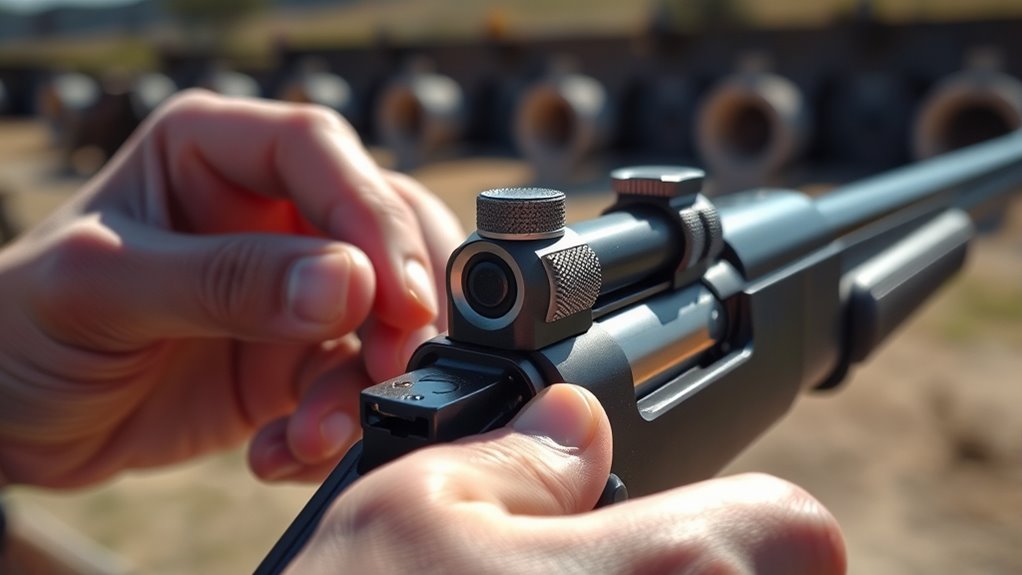
Adjusting the windage screw is crucial for hitting your target accurately left or right.
Proper windage adjustment helps you correct horizontal misalignments, making sure your sights are centered.
Start by shooting a group at a known distance, paying attention to where the shots land horizontally.
If they hit to the left, turn the windage screw clockwise; if they go to the right, turn it counterclockwise.
Make small adjustments—about a quarter turn at a time—and shoot again to see the effect.
Repeat this process until your shots consistently land in the center horizontally.
Remember, small and deliberate turns give you better control over your lateral alignment.
Keep track of your adjustments so you can remember how many clicks work best.
With proper windage tuning, your sights will be more accurately aligned, giving you better left-right consistency and more confidence in your shots.
Test Your Sights at the Range to Confirm Precision
To ensure your sights are properly aligned and accurate, it’s crucial to test them at the range in real shooting conditions. Start by shooting at a consistent target from a fixed distance.
Focus on confirming your scope mounting is secure and that your laser alignment, if used, stays true with your iron sights. Record your shot groups and note any deviations.
Use the table below to visualize your results:
| Distance | Shot Group Size | Notes on Sight Alignment |
|---|---|---|
| 25 yards | 2 inches | Slight right drift, adjust scope |
| 50 yards | 3 inches | Consistent vertical impact, check laser calibration |
| 100 yards | 5 inches | Need minor windage correction, verify sights |
This practical test makes it easy to pinpoint adjustments needed for precision. It helps ensure your iron sights are finely tuned for accurate shooting.
Troubleshoot Common Sight Adjustment Issues
If your sights still aren’t lining up the way they should, start by taking a close look at some of the usual suspects like loose screws or bent parts. Sometimes, a simple tighten or straighten-up can make all the difference.
Next, double-check that your sights are properly aligned with the barrel—making sure they sit perfectly straight and centered. Also, don’t forget to verify that your windage and elevation adjustments are set correctly so you’re aiming true.
Once you’ve addressed any issues you find, head out to the range again and test your shots. Hopefully, with these tweaks, your accuracy will start to improve and your sight picture will be much clearer.
Identify Common Misalignment Causes
Misalignment issues often come from simple mistakes or factors that are easy to overlook and can throw off your sighting. For example, installing new sights without proper adjustments can cause early misalignment. Make sure everything is installed and tightened correctly.
Your shooting technique also plays a role. A poor grip or an inconsistent stance can make it seem like your sights are off, even if they’re perfectly aligned. Practicing a steady, correct stance helps keep everything on point.
Upgrading your equipment means you might need to readjust your sights. Always realign after any modifications to stay on target.
Incorrect sight picture errors are common, so practicing proper technique is key to accuracy.
Environmental factors like wind or changing light conditions can shift where your shot lands. Be aware of these elements and adjust for them when shooting.
Check Proper Sight Alignment
Ensuring proper sight alignment starts with inspecting your sights and your shooting stance carefully. Begin by checking that the front and rear sights are correctly aligned and centered.
Do a visual calibration by focusing on the sights, not the target. Make sure the front sight is level within the rear notch. Confirm that the sights are straight and not tilted, because misalignment can affect your accuracy.
Hold your firearm steadily, keeping a consistent stance. Look at the sights from a natural shooting position. If the sights aren’t aligned during your inspection, adjust them temporarily to see clearly before fine-tuning their position.
Proper visual calibration makes sure your sights are aligned correctly for accurate shooting.
Adjust for Windage and Elevation
Adjusting for windage and elevation is key when your sights aren’t hitting the target as expected, especially in different weather conditions or at various ranges. Proper windage calibration makes sure your sight moves left or right to line up with your point of aim and impact.
To do this, turn the windage screw gradually to the left or right depending on where your shots are landing. Elevation adjustment moves the sight up or down to compensate for bullet drop or rising trajectories.
Make small tweaks and fire a test shot after each one. Accurate windage and elevation calibration can really help improve your shot placement. Always check your adjustments at the range to ensure your sights are aligned for the conditions you’re shooting in.
Maintain Your Iron Sights for Consistent Accuracy
To keep your iron sights performing accurately, regular maintenance is essential. Sight upkeep includes cleaning, checking for damage, and making sure everything is aligned properly. Keeping your sights normalized helps keep them centered and consistent, so your shots stay precise.
Here’s a quick visual to help with maintenance:
| Step | Action | Purpose |
|---|---|---|
| Clean | Use a soft brush or cloth to remove debris | Remove dirt and prevent corrosion |
| Inspect | Check for dents or misalignment | Maintain proper sight function |
| Tighten/Adjust | Make sure screws are secure and sights are aligned | Keep your sights stable |
Doing these steps regularly extends the life of your sights, boosts accuracy, and helps keep your shots on target. Consistent sight maintenance is the key to dependable performance shot after shot.
When to Seek Professional Help for Sight Calibration
Have you noticed your shots are consistently off even after fine-tuning your iron sights? That’s a sign it might be time to seek professional help. If simple adjustments don’t improve accuracy, inspecting sight durability is vital.
A professional gunsmith can evaluate if your sights are worn or damaged, ensuring they remain reliable under scope safety standards. Attempting complex re-calibrations without proper tools risks misalignment, which may compromise safety and accuracy.
Furthermore, if your sights are difficult to adjust or feel unstable, a specialist can correct these issues safely. Trusting a professional prevents accidental damage and guarantees precise calibration.
Frequently Asked Questions
How Often Should I Check My Iron Sights for Accuracy?
You should check your iron sights for accuracy regularly, especially before important shoots or if you notice any impact issues.
Keeping your sights in good shape helps ensure your aim stays precise. Rechecking them early can catch any shifts before they cause problems.
During practice, take time to refine your aiming techniques. After rough handling or shooting sessions, it’s a good idea to verify your sights as well.
How often you check depends on how much you use your firearm, but doing it once a month is a solid rule of thumb to keep everything reliable and accurate.
Can Different Types of Firearms Require Unique Sight Adjustments?
Yes, different firearms may need unique sight adjustments because of variations in sight calibration and compatibility. Factors like the firearm’s design, barrel length, and recoil pattern all influence how your sights should be aligned.
It’s important to check the manufacturer’s recommendations for each firearm and adjust your sights accordingly. Doing this helps ensure you get accurate, safe, and reliable performance across different guns.
What Signs Indicate My Sights Need Realignment?
Your sights might be off if your shots consistently hit far from your target or if your groups are scattered. It’s like trying to hit a moving train with a bow and arrow!
Signs include your point of impact not matching your aim or seeing sight misalignments in your sight picture.
Use proper adjustment techniques, like windage and elevation tweaks, to realign your sights. This helps you regain that pinpoint accuracy you want.
Is There a Preferred Method for Sight Adjustment for Beginners?
As a beginner, the preferred method for sight adjustment involves focusing on sight alignment and making precise windage corrections.
Start by ensuring your sights are aligned with your target. Then, adjust the windage screw to correct any drift left or right.
Take steady aim, fire a shot, and see where it hits. Repeat these steps, fine-tuning your sights until your shots hit consistently at your target.
How Do Environmental Conditions Affect Sight Accuracy?
Like a lighthouse battling stormy seas, your sight accuracy faces environmental factors and weather conditions. Wind, rain, fog, and lighting changes can shift your aim subtly but considerably.
These elements distort visibility and stability, making precise shots harder. You need to adapt like a sailor adjusting sails, recognizing that environmental conditions influence your sights.
Staying aware and making adjustments help you maintain accuracy despite nature’s unpredictable forces.
Conclusion
By fine-tuning your iron sights, you unlock a new level of confidence and precision in your shooting. Think of it as crafting a secret handshake with your firearm—subtle, yet powerful. With a little patience and practice, you’ll find your aim becomes sharper and more dependable.
Remember, even the best marksmen occasionally seek expert advice to perfect their technique. Welcome the journey of improvement and watch your skills steadily raise to new heights.
Adjusting your iron sights might seem small, but it makes a big difference in accuracy. Using the right adjustments ensures you hit your target more consistently and confidently.
So, take your time with the process. With practice, adjusting your iron sights will become second nature, making you a more precise shooter.